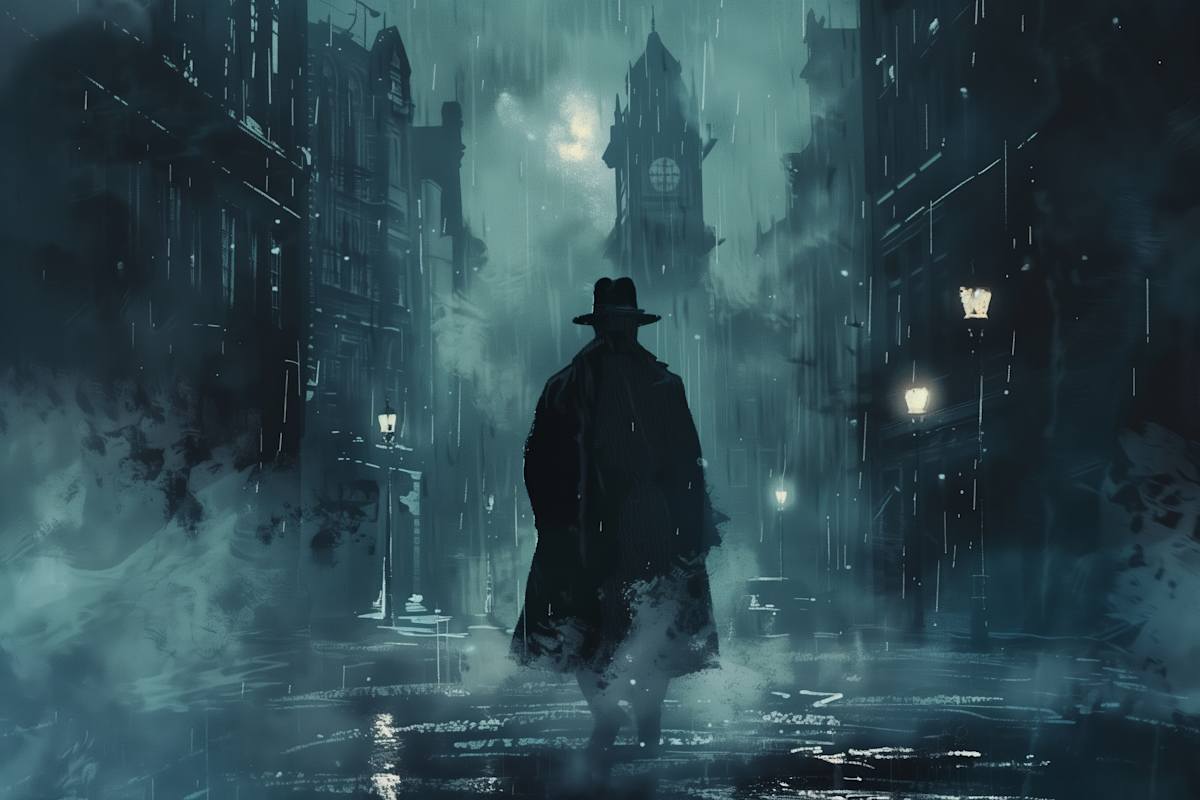
Britain has a long and often unsettling history of unsolved murders.
Some cases have remained mysteries for decades, despite police investigations, witness interviews, and extensive searches. Others have generated theories that have endured for generations, becoming part of the country's true-crime folklore.
What makes these cases particularly compelling is not simply the brutality of the crimes. It is the unanswered question that remains afterwards.
Who was responsible?
Why did they do it?
And how did they manage to disappear without facing justice?
From Victorian London to post-war Britain, some of the country's most notorious murders remain officially unresolved.
Here are some of the most famous.
Jack the Ripper
Few unsolved murder cases are as famous as those attributed to Jack the Ripper.
In 1888, a series of brutal murders took place in London's Whitechapel district. At least five victims are traditionally associated with the killer, although the exact number remains disputed.
The murders generated enormous public interest and were followed closely by newspapers of the day. Letters allegedly written by the killer added to the growing sense of fear surrounding the case.
Despite a huge police investigation, no one was ever convicted of the murders.
Over the years, numerous suspects have been proposed, from local criminals to doctors and members of the aristocracy. Books, documentaries, and countless theories have continued to examine the evidence.
More than a century later, however, the identity of Jack the Ripper remains unknown.
The case has become the ultimate example of an unsolved murder mystery: a crime committed in the heart of one of the world's largest cities, followed by an investigation that failed to identify the killer.
The Murder of Julia Wallace
In January 1931, Julia Wallace was murdered at her home in Liverpool.
Her husband, William Herbert Wallace, became the central figure in the investigation after police discovered Julia's body at the house.
The case contained one of the strangest elements of any British murder investigation.
Wallace had received a message instructing him to visit a house at a particular address. When he arrived, there was no one there.
When he eventually returned home, he discovered that his wife had been murdered.
Wallace was arrested and convicted, but the case against him was controversial. His conviction was subsequently quashed on appeal.
No alternative suspect was ever convicted.
The murder has fascinated criminologists, writers, and true-crime enthusiasts ever since. The strange sequence of events surrounding the supposed appointment has led to decades of speculation over whether Wallace was the victim of an elaborate deception or whether there was another explanation.
The question of who killed Julia Wallace remains unanswered.
Bible John
During the late 1960s, three young women were murdered in Glasgow after visiting the Barrowland Ballroom.
The murders of Patricia Docker, Jemima McKinley, and Helen Puttock were linked to a man who became known as Bible John.
The killer reportedly spoke to his victims about religion and morality before accompanying them after they left the dance hall.
The murders created fear across Glasgow, particularly among young women who regularly visited the city's dance venues.
Despite a major investigation and the questioning of numerous suspects, Bible John was never conclusively identified.
One of the most frequently discussed suspects in later years was convicted murderer Peter Tobin. His possible connection to the crimes generated considerable speculation, but no definitive evidence established that he was Bible John.
The case remains one of Britain's most enduring unsolved murder mysteries.
The Disappearance of Genette Tate
Not every unsolved murder begins with the discovery of a body.
In August 1978, 13-year-old Genette Tate disappeared while delivering newspapers near her home in Devon.
Her bicycle and newspapers were found abandoned, but Genette herself was never seen again.
Despite extensive searches and a major investigation, her body has never been recovered.
The case became one of Britain's most haunting missing-person investigations. Over the years, investigators examined several possible suspects, including convicted child murderer Robert Black.
Black was later linked to the disappearance but was never charged with Genette's murder.
The absence of a body has made the case particularly difficult to resolve. Without knowing exactly what happened to Genette, investigators have been left with fragments of evidence, theories, and unanswered questions.
More than four decades later, her disappearance remains an open mystery.
Why Do These Cases Remain Unsolved?
It is easy to imagine that a murder investigation should eventually produce an answer.
In reality, investigations can be undermined by a combination of circumstances.
Witnesses may remember events differently. Important evidence can be lost or contaminated. Suspects can die, disappear, or move abroad. Investigative techniques that are standard today may not have existed when the crime occurred.
There is also the problem of time.
As the years pass, witnesses die, and memories fade. Documents disappear. Buildings are demolished. Places change beyond recognition.
For historic cases, investigators may have to reconstruct events using evidence that is decades old.
Modern forensic science has provided new opportunities in some cases, particularly where biological evidence has survived. DNA profiling, improved fingerprint analysis, and advances in digital investigation have all given detectives tools that were unavailable to previous generations.
But forensic technology cannot solve every case.
Sometimes the crucial piece of evidence was never collected.
Sometimes it has disappeared.
And sometimes the person responsible simply left behind too little evidence to identify them.
The Enduring Fascination with Unsolved Murders
Why do these cases continue to fascinate us?
Part of the answer lies in the absence of an ending.
A solved murder has a conclusion. There is a suspect, a prosecution, and, in many cases, a conviction.
An unsolved murder is different.
The story stops before the final chapter.
That leaves room for questions, theories, and speculation. Every piece of evidence can be examined again. Every witness statement can be reconsidered. Every suspect can be reassessed in the light of modern knowledge.
For families of victims, however, an unsolved case is much more than a mystery.
It represents years, sometimes decades, without answers.
Behind every headline and every theory is a real person whose life was taken and a family left wondering what happened.
That is why cold cases continue to matter.
Could Britain’s Unsolved Murders Still Be Solved?
A case being old does not necessarily mean it is forgotten.
Advances in forensic science have transformed the investigation of historic crimes. DNA technology in particular has allowed investigators to revisit evidence that may once have appeared to offer little hope.
Cold-case teams can also approach old investigations with fresh eyes, examining evidence and witness accounts using techniques and knowledge unavailable when the original investigation took place.
That means some of Britain's most famous unsolved murders may still have a final chapter waiting to be written.
Until then, the questions remain.
Who was responsible?
What really happened?
And why did the truth remain hidden for so long?
For the families involved, those questions have never gone away.